
- As an ICDAR 2026 reviewer (Program Committee member), can I delegate reviews assigned to me to someone else I know?
- Where can I find the Domain Conflicts and Conflict of Interest form?
- What if not all co-authors completed the Conflict of Interest form?
- Is it mandatory to enter Domain Conflicts?
- How do I add my Domain Conflicts?
- Do we need to strictly follow the Springer LNCS margins and font size?
- Can I submit a paper that is already on arXiv?
- Can I submit supplementary material?
- Can authors be added or reordered after submission?
- Is remote attendance possible?
- Who can I contact for CMT-related issues?
- Does each co-author need to declare conflicts individually?
- Is adding ORCID information mandatory?
- I want to submit a „dataset paper“. Does the dataset need to be publicly available at the time of submission?
- Who can answer questions about paper formatting?
As an ICDAR 2026 reviewer (Program Committee member), can I delegate reviews assigned to me to someone else I know?
The short answer is „no.“ When we invited leaders in the document analysis research community to serve as PC members, it was with the intention that they would take personal responsibility for all of the papers assigned to them. While the option of delegating reviews was a practice in past conferences, this is no longer the case.There are good reasons for this change. The integrity of the review process is very important, both to the conference itself and also to the publisher of our proceedings, Springer-Nature. Numerous emails were sent to reviewers before the start of the review period reminding them to fill out their domain conflicts and also their topic areas. This is to avoid conflicts of interest and help align submissions with reviewers who are qualified. Springer-Nature requires that we provide affiliation details for everyone involved in helping to decide the ICDAR program, including all of our reviewers. This is because some „bad actors“ are using fake peer review processes, where reviewers are not truly independent and where authors „pay to publish“ low quality papers. By identifying those involved in determining the program and their affiliations, we provide assurance that ICDAR 2026 is a high-quality conference with a rigorous review process.
I don’t understand where to find the Domain Conflicts and the Conflict of Interest form mentioned in the warning page.
Both are accessible from the author CMT account interface:Domain Conflicts Domain conflicts are declared per author and are linked to each author account.
- Go to your Author Account
- Open the Domain Conflicts section
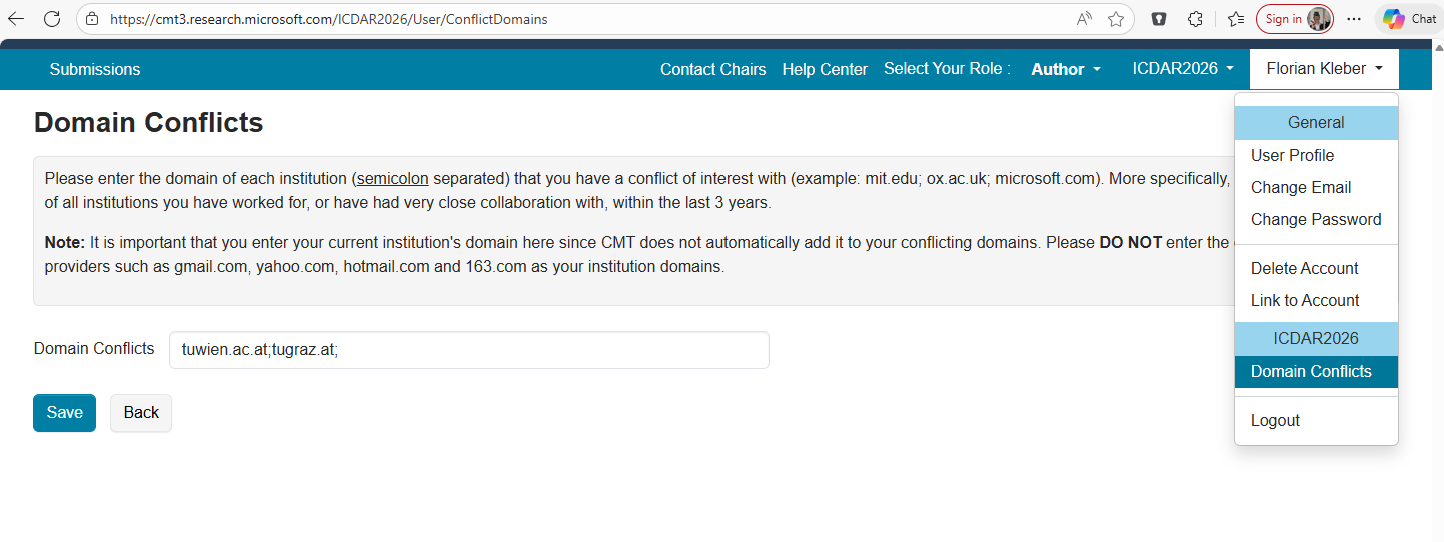
- Declare the relevant domain conflicts
Conflict of Interest Form The Conflict of Interest form is available in a paper preview interface.
I’m worried that not all co-authors have completed the conflict of interest form before the deadline. Has my paper already been desk rejected?
No. Your paper has not been desk rejected yet. Authors will be allowed to complete or update conflict of interest information in CMT until desk rejections begin after the full paper deadline (a notification email will be sent beforehand). Please note that: Each author must be registered in CMT Each author must use the same email address as used for the submissionIs it mandatory to enter one’s domain conflicts?
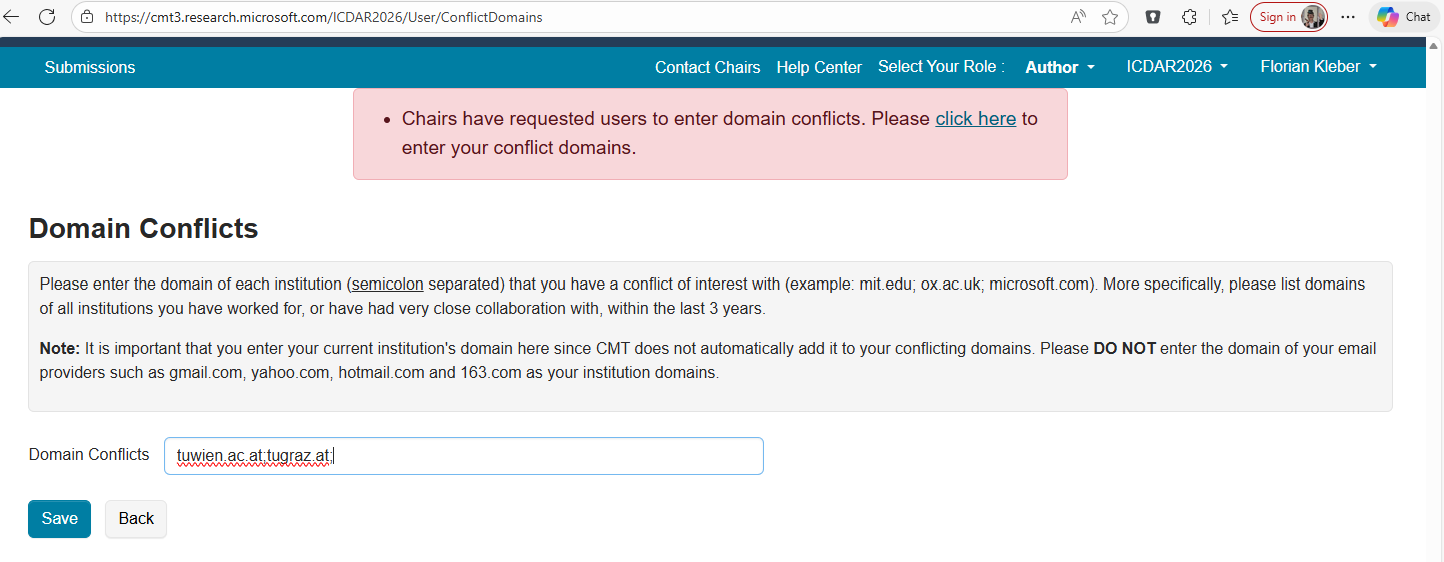
Yes. Domain conflicts must be entered by all authors to avoid desk rejection. Domain conflicts must also be entered by reviewers; otherwise: They will not be assigned any paper They will not be listed as members of the Program Committee of ICDAR 2026How can I add my domain conflicts?
When you log in to CMT, you will see a request from the Chairs displayed in a reddish box. Within the same box, you will find the link to enter your conflicts. Or follow the instructions above.Do we need to follow the page margins as well as font size in the Springer LNCS template for our manuscript?
Yes. Parts of tables and figures that exceed the Springer LNCS margins will not be visible in the camera-ready version and should already be avoided at submission. According to standard layout rules: Manuscripts should be readable without zooming Font size requirements apply not only to text, but also to tables and figures We anticipate that it is possible to clearly present your project and results within the allowed 17 pages without pushing formatting limits.Is it possible to submit a paper that has already been submitted to arXiv?
Yes. Papers submitted to arXiv can be submitted to the conference, as arXiv hosts unreviewed material.How can I submit supplementary material?
No supplementary material can be submitted.Will it be possible to add an author or to change the authors‘ order after submission?
No. This will not be allowed.Will it be possible to attend the conference remotely?
Presentations are intended to be onsite.I have some questions about the CMT interface. Who can I contact?
For any issues related to CMT, please contact the publication chairs at: [email protected]Does each co-author need to individually declare their domain conflicts, or is a single declaration sufficient?
Each author must: Be registered in CMT Individually list their domain conflicts of interest A single declaration by the corresponding author is not sufficient.Shall we add the ORCID numbers for paper authors?
The template includes a placeholder for ORCID numbers, but their inclusion is optional.I want to submit a „dataset paper“. Does the dataset need to be publicly available at the time of submission?
A new dataset that is claimed to be the major contribution of a submitted manuscript (a so-called „dataset paper“) needs to be available at the time the camera-ready manuscript is uploaded to the publisher at the latest, assuming the paper is accepted. If possible, it is helpful to be able to refer to the full published dataset also in the submitted paper. However, in such cases you should take care that the identity of authors cannot be easily revealed via metadata published along with the dataset. Note: reviewers will be advised not to undertake any special efforts to try to reveal the identities of authors.It is not necessary for the full dataset to be available to reviewers at the time a manuscript is submitted. However, meaningful statistics summarizing the key characteristics of the dataset and representative samples from the dataset should be provided. Note: whenever possible, such sample material should be made available in a way that preserves anonymity of authors for the double-blind review process.